Showing posts with label Comics. Show all posts

2.08.2009

Fun Stuff from Rod Espinosa

Somehow or another Antarctic Press has managed to exist as a comic company for a quarter of a century without my ever really having taken notice of them before. Well okay, I did pick up an issue or two of Warrior Nun Areala back in the day-- I had to know what that was all about. But for the most part I haven't really paid much attention-- I've never gotten way into manga, so American manga sounded like an even iffier proposition. In a way though, Antarctic's output could be seen as more accessible than traditional manga: they're released in American comic-sized bites, they read front to back, they're in color. They're an interesting alternative for U.S. readers who don't get manga.

Filipino-born Rod Espinosa is not only Antarctic's VP of Production, but also one of the more prolific creators producing for the company. As far as I can tell from the credits, Espinosa does it all: writing, penciling, coloring, he might even letter his stuff as there is no separate letter credited. Scanning the shelves for outer spacey goodies to review, I ended up with not one but two recent Rod Espinosa graphic novel releases: the first volumes of Prince of Heroes and Dinowars, two books laden with fantastic imagery, imagination and fun exciting action.

Prince of Heroes is a coming of age tale told over a space opera backdrop. The young protagonist Ronen Ladarna has grown up in humble surroundings, but was born into a powerful clan and has a greater destiny. What's a bit unorthodox about the setup is that Ronen is already aware of this at the beginning of the comic. Usually in these kind of tales the hero is unaware of the secrets of his past and he and the reader become aware of things together as the story progresses. But in Prince of Heroes everyone in the story knows what's going on well before the reader does; some key information isn't really explained until halfway or even three-quarters of the way through the book. Only towards the end do you start to get the picture of what really should have been explained in the early pages.

For thousands of years, the galaxy has been under the dominion of the powerful elitist clans of the Greater Darem Empire. Ronen was born into one such clan, but for unrevealed reasons his mother Aiymie took him away to live an obscure childhood on a frontier world. Now that she has decided that Ronen is old enough to be introduced to his father and formally claim his rightful place, the two of them have been slowly making their way back to the core-- moving as far as their finances will get them and then stopping to earn more and get them further along.

Ronen has grown so fond of living the life of a simple farmer on their latest world of Irdne, that he isn't really sure that he cares about his lineage. He counts many locals among his close friends, including a martial arts master named Ze, wheelchair-bound and blind but still commanding great respect, and his wards Tenny and Zeb, who are like younger siblings to Ronen. He and his mother also have three fuzzy family servants who are as skilled in battle as they are in farming. Ronen identifies so strongly with the locals that he stands against fellow Darems of the Mesozora clan who arrogantly throw their weight around and terrorize the local populace. Because of the increased size and strength of Darems, this leads to an epic-scale hyperbolic martial arts battle that takes up a goodly chunk of the first book.

If you like space opera as much as I do, this is a intriguing beginning to what could develop into an great saga. Ronen's life is thrown into chaos when open rebellion on the frontier causes the withdrawal of Darem colonists in the face of local violent uprisings. One young man caught up in the great historical events of his time is the stuff of legends, and by the close of the first volume Espinosa had me ready and eager for the next installment.

On the other hand, if big epic space opera is not really your thing, hows about rampaging cyborg dinosaurs stomping across the Earth and trying to wipe out humanity? That's the premise of Dinowars, Espinosa's other recent graphic novel release. It's a bit light and not particularly sophisticated, but as a quick fun read of armies battling dinosaurs, it does its job.

Here's the high concept: millions of years ago, dinosaurs evolved into sentient tool-users known as Triassians. The reason humanity has remained ignorant of this development is that when warned of the imminent approach of a deadly ice age, these intelligent saurians built spacefaring craft and left the Earth. After eons spent floating around the asteroid belt in hibernation, this advanced civilization rains down from the sky, and they want their homeworld back! One faction, called the Protosaurs, are willing to negotiate, but the more murderous Megasaurs see humanity as a pestilence to be wiped out. Two human heroes are at the center of the action as it unfolds.

Commander Hank Armstrong is the kind of square-jawed all-purpose military hero that you can only find in comics. When we first meet him, he is the first astronaut to set foot on the moon in forty years. When they uncover cybernetically enhanced dinosaurs on the surface, he barely makes it back to his shuttle. Upon his return to Earth, Armstrong picks up a machine gun and is suddenly leading ground forces against the invaders. Why army personnel would gamely take orders from a passing astronaut is beyond me. At the climax, he hops aboard a prototype bomber with a mystery weapon, and sudden he's a jet pilot. He's such a mack daddy that when he flies into combat for the final battle, he has a hot babe strapped to his lap the whole time!

The babe in question would be Debra MacDonald, a small-town waitress from Nowhere, Texas. Her dead-end life takes a sharp turn when Protosaur emissaries crash land on her family farm, and soon mindlink with her so that she can be their interpreter. Before long, this humble server is addressing the United Nations with the Protosaurs' wishes to populate Antarctica. And wouldn't you know it, when Debra and Hank cross paths, it turns out that they were high school sweethearts who broke up at the prom! What are the odds?

Espinosa's greatest strength is his artwork, which yes is manga-inspired but is more lovingly-wrought and detail-oriented than a lot of stuff I see coming out of Japan when I'm at the bookstore skimming. He has a great design sense, whether he is conjuring up cyber-saurs, extraterrestrial beings, starships or alien artifacts, it all looks great. He's equally adept at cute heroines or state-of-the-art military hardware. Espinosa also clearly makes use of computer rendering for a lot of his designs, which is sort of a double-edged sword. On the one hand, it allows him the ability to create meticulous highly detailed cityscapes which border on breathtaking. However, the digital and line art doesn't meld together as well as it might: buildings all look too pristine, too symmetrical. If Espinosa can figure out a way to give his CGI work a worn look and make it blend better, it would look way better. Espinosa also has a tongue-in-cheek cheesecake element to his female characters which I find fun but may exasperate others. Female characters tend to get their clothes shredded and the woman who faces Ronen in combat ends up face-down, ass in the air in a blatantly submissive position more than once.

Bottom line, both of these books are capital-F Fun. The Dinowars pocket digest has a prominent "1" displayed on the cover and spine, but frankly the book has enough closure to satisfy me, and I don't think there's enough going on there to make me want to come back for a second round. It was enjoyable enough, but Prince of Heroes is the story I'm eager to see more of. Ronen's story is just beginning, he's only just headed into space and his destiny as the first volume comes to a close. Now's the time to jump aboard and see where the story is headed. Espinosa has helpfully posted the first volume online, which seems like an odd strategy while trying to sell a book of the same material, but at least readers can judge whether they want to preorder Prince of Heroes Volume 2, the first issue of which is being solicited this month. I'm on board.

Dinowars Rating: 7/10
Prince of Heroes Rating: 7.5/10

2.03.2009

Star Trek: Countdown #1

If there's anyone else out there who's been anxiously awaiting for more info to trickle out about the new Star Trek movie, a few interesting links have hit the net in the past couple of weeks:

JJ Abrams Explains How Only He Can Stop Get the Trek Franchise Out of the Shadow of Star Wars.

Esurance Had a Neat Featurette About the Film with Footage as Well as a Contest to Attend the Hollywood Premiere.

Playmates has Revealed a Slew of Toys Tying into the Film.

Pocket Books Plans to Stick to the Tried and True Original Timeline for the Forseeable Future

Okay, This Do-It-Yourself Star Trek Chart Has Nothing to Do with the Movie-- But I'm Throwing It In Anyway

But probably the mother lode of clues to what the new film will be about would be the Star Trek: Countdown limited series from IDW, billed as the official prequel. Since Star Trek screenwriters Roberto Orci and Alex Kurtzman have a "story" credit for the first issue, there's a good chance that this 4-issue mini will provide some impactful backstory to lead into the May '09 release. Because I'm so obsessed with trying to figure out how much I'm going to love or hate the movie, I'll be combing through this series with more spoiler details than I usually get into. So if you are trying to keep reasonably ignorant before getting to actually see the film, this is not the post for you.

Although the Abrams film is famously about the early days of Kirk and crew, the origins of the tale take place in the 24th century, sometime after the events of Nemesis. How long after is a little unclear so far. The wizened Ambassador Spock reflects in internal monologue that he has been on Romulus for "four decades"-- "Unification" plus 40 years would place the mini about 29 years after Nemesis. However, in a review on Trekmovie.com, Alex Fletcher decoded the stardate and claims it's just 8 years later. Here I thought stardates were arbitrary claptrap... who knew they actually meant something? Hopefully future issues will clarify when we are, but I guess all we really need to know is that Spock has devoted his life to trying to unify the Romulans and Vulcans for a good long time now.

The issue open with Nero, destined to be the big bad of the film, but here he is just the captain of a mining ship trying to make a living on the fringes of Romulan space. No tattoos or vengeful 'tude, (nor, for that matter, does he wear a quilted gray jumpsuit with giant shoulder pads) just a hard-working guy providing for his emerging family. During a fateful mission in the Hobus system, Nero and his crew get a firsthand look at a dangerous threat to the Empire-- the system's star is losing stability and threatens at any time to go supernova. They barely warp out in time before a rampant solar flare destroys the planet they were mining on moments before.

Back on Romulus, Spock addresses the Romulan senate. For many years our old friend has been working underground, but in the past five years has become the official Federation Ambassador to Romulus. In that capacity, Spock warns that the destruction of Horus may be so powerful that the entire Empire could be consumed. This is met by disbelief and derision from the Senate, particularly when Spock explains that the only way to quell the star is by allowing the Vulcans to process the Empire's highly valuable store of decalthium into "red matter" which will create a black hole to counter the supernova (technobabble, anyone?) Much like the Kyrptonians ignoring doomed Jor-El, the Romulans are dismissive of Spock's findings and promise only to investigate further. Apparently after all this time, there is still no love lost between these galactic cousins, so much so that the Romulans would rather risk annihilation than trust Vulcan to take control of their highly valuable isotope.

Although he always considered himself a loyal servant of the Empire, Nero can't sit idly by and wait for bureaucrats to decide the Empire's fate. With the lives of his family and his people in the balance, he makes the only choice he really can, which is to offer the services of his ship and crew to Spock in order to mine some decalthium without the Senate's knowledge or permission. No sooner are they in range of their goal than a couple of quick plot twists occur to close out the issue-- c'mon I can't spoil the entire thing.

The comic's credited writers are Mike Johnson and Tim Jones, so I don't know how much they are responsible for or what came from Orci and Kurtzman. What we have here is a perfectly okay setup that unfolds a little on the slow side, and so far is just a little too neat of a predicament. A supernova that can only be stopped by a certain element and the aid of a distrusted world? Convenient. I assume all involved are aware of Superman's origin. The artwork, by David Messia is serviceable but unspectacular. I like his ships and technology better than his people and his action.

You can see that this won't end well, although how Nero will end up so hateful and wanting to destroy Vulcan is not yet clear. Also, I still can't predict what the time travel in the movie will accomplish, even if the star does end up destroying the Empire, as seems inevitable. Or rather, why the movie Nero will be obsessed with destroying Vulcan and/or Spock-- if he's traveling in time anyway, why not cook up some "red matter" at his leisure and then go back and throw it in the star before it becomes a threat! Oh well, maybe I'm anticipating too much, I should just wait for the rest of the series to come out...By the way, naming your protagonist "Nero" in a story where a planet called Romulus is in danger of burning? Cheesy!

Rating: 7/10

1.26.2009

Terminator vs. Terminator

In the past few weeks, two different Terminator #1’s have hit the streets, not surprising as anticipation for the fourth film grows as we get closer to its May 22nd release. What’s strange about it, though, is that these comics are coming from two different companies, one from Dynamite and the other from IDW. It boggles my mind that competitors can both possess the rights to produce comics from a popular franchise at the same time, but since this unique situation has arisen, the only logical thing to do is to seal these 2 books up in a mylar bag and have them go at it, robo y robo, until one book emerges victorious.

It’s Terminator fight night!

Ladieeeees and Gentlemen, in this corner, weighing in at $3.50 for 22 pages of story, is Terminator: Revolution #1 by Simon Furman and Lui Antonio.

Annnnd in this corner, weighing in at $3.99 for 22 pages of story, is Terminator: Salvation #1 from Dara Naraghi and Alan
Robinson.

Okay let’s have a dirty filthy fight, no holds barred annnnnnd…
Fight! Fight! Fight!

Round One: The Introduction

Revolution: This may be a first issue, but we learn from the recap page that this mini continues on from at least one previous series. "Kate Bewster" has died a year previous and John Connor received help from a terminator called "Uncle Bob" in fleeing Crystal Peak, whatever that is. By the way, isn't Kate's name "Brewster"? Nice copyediting. Also, according to the IMDB, Kate is alive and well in film 4, which means these comics represent yet another alternate version of the Terminator storyline, separate from both the movies and the TV show (which already conflict with each other).

Salvation: Billed as an official movie preview, this comic flows directly from the events of Rise of the Machines. As long as you've seen the three movies, or even just the last one, you're golden.

Winner: Salvation.

Round Two: The Setting

Revolution: A bunker in New Jersey, plus the blasted environs of its perimeter. Also, in the past, a trailer in 1996 New Orleans.

Salvation: Opens with a globe-spanning montage as John Connor sends out a message of hope and resistance to the remains of humanity. Shots of the Capitol, Forbidden City and Taj Mahal (among others) in smoking ruins bring home how much civilization has lost under the reign of Skynet. The action of the story unfolds on two fronts, a resistance HQ in Detroit and a refugee camp in Arut, Niger. In just a few pages this book does a much better job in establishing just how far the nations of the world have fallen.

Winner: Salvation

Round Three: The Characters

Revolution: John Connor and his new wife Tara are the center of attention, which a short appearance by a young Kyle Reese. The rest of the freedom fighters are basically just cannon fodder. In the past, we're back with Sarah Connor (looking nothing like Linda Hamilton) and young whiny John.

Salvation: With John relegated to a voice on the radio and a brief flashback scene, the main characters here are from a range of ethnicities and cultures, united as one against the common aggressor, the machines. The resistance here come off as real people, not a bunch of rednecks in camoflage.

Winner: Salvation.

Round Four: The Action

Revolution: While waiting to kick his latest operation into gear, an attempt to wrest control of a missile command center from Skynet, John Connor sits around his bunker being anxious and fretting about when Terminators are going to try and come wipe out his new wife. And then one does, in the form of the highly advanced T-Infinity model. Meanwhile, in 1996-- well you know the score: Sarah and John are on the run, and Terminators are trying to kill them. Rather than just one, Skynet has sent 8 of them after the Connors this time.

Salvation: Similarly, a plan is afoot to thwart a Skynet uranium mine, but meantime Resistance leader Elena Maric tries to convince an underground survivalist community to stop hiding and take a stand against the enemy. Both Detroit and Arut come under assault by robotic forces.

Winner: It's a draw; both have a healthy dose of gunfire and explosions.

Round Five: The Artwork

Revolution: This is where this book really falls down: in Antonio's vision of the post-apocalypse, everyone is pretty and buff and runs around in tank tops to show off their physiques. Tara Connor is supposed to be a respected resistance leader, yet she runs around with her big boobs barely restrained by her skimpy top and thong straps showing out of her pants. Cause, you know, when you are fighting a losing battle to save humanity from extinction, you wouldn't want your panty lines to show through your cargo pants! Also the T-Infinity looks mighty super-heroey for the dystopian setting, he kinda resembles Mr. Freeze's long lost brother.

Salvation: Robinson's pencils are much more appropriate for the milieu in which the story is taking place. Far from being glamorous and beautiful, the characters have... well, character. They come in different shapes and sizes, look frazzled and dress more in keeping with desperate freedom fighters eking out an existence in a ruined world. The depiction of the shattered world monuments in the opening pages alone are more interesting than anything in Revolution.

Winner: Salvation.

And by the unanimous verdict of the judges, the winner and champion is:

IDW's Terminator: Salvation #1 for sure. Revolution is just a very by-the-numbers story with little to set it apart from other Terminator stories, drawn too bright and superheroish. Salvation does a much better job of reflecting the saga as a worldwide event, with dark atmospheric artwork and interesting characters to become invested in. Presumably Naraghi and Robinson were able to get a look at script and artwork from the upcoming film; this comic makes me look forward to its imminent release that much more.

Revolution rating: 6/10
Salvation Rating: 8/10

1.25.2009

DnA Domination

Although they have been making quite a name for themselves of late, writing collaborators Dan Abnett and Andy Lanning-- known collectively by their fans as “DnA”, are the exact opposite of an overnight sensation. In fact, these guys have been in the trenches for years, paying their dues both as a team and separately. Abnett is a prolific and versatile writer all on his own, with credits ranging from Warhammer 40K to Wallace and Gromit children’s books. Lanning is an accomplished inker on tons and tons of DC and Marvel books. But right now, as a team, they are hotter than ever, being primarily responsible for bringing back the cosmic in the Marvel Universe and making space heroes more prominent at the company than they’ve been in a decade.

Marvel has a lot of great cosmic storylines on their resume, but those kind of stories hit a sort of fallow period for awhile, with characters like the Silver Surfer and Warlock unable to sustain ongoing titles in the post-90’s post-bankruptcy period. Keith Giffen deserves a lot of the credit for rethinking the genre with 2006’s Annihilation event, but ever since he defected to DC, DnA have taken the ball and run with it. They spearheaded an Annihilation sequel called Conquest and are now gearing up to pit the Kree against the Shi’ar in War of Kings. In addition to their big hoo-hah event, Abnett and Lanning are currently responsible for both of the big monthly space opera books on the block, the newest incarnations of Nova and Guardians of the Galaxy.


The first 12 issues of Nova have just been released in a handsome oversized hardcover, which makes for a satisfying afternoon of reading. This series marks Richard Rider’s fourth(!) attempt at carrying an ongoing title, but I feel that this time we may have a winner. One possibly fatal flaw of previous attempts was that although his powers and shiny space helmet originated from outer space, Nova spent most of his time earthside, angsting about his life and knocking out costumed super villains. He was basically a surly Peter Parker with a bucket on his head. DnA have sent him out amongst the stars, where he’s filling the all-encompassing “protector of the universe” role in the tradition of Captain Marvel and Quasar.

As his latest series opens, Rich is the last surviving member of the Nova Centurion Corps, the galactic peacekeeping force that was wiped out by the Annihilation Wave. I confess it was news to me that the Corps has become so widespread across the cosmos-- back in the day they were strictly local protectors of the planet (and later domed city of) Xandar. When exactly they expanded to become Marvel’s answer to the Green Lantern Corps I have no idea, but I guess it’s not important since they’re all dead now anyway. Richard Rider is more powerful than ever because he possesses the cumulative power of the entire Corps and also houses the vast computer knowledge of Xandar’s Worldmind in his noggin. He also feels a tremendous burden to single-handedly carry on the Nova Corps tradition, to be a protector to all worlds at all times, responding to constant back-to-back distress calls. Not surprisingly, Rich is beginning to burn out a bit.

As the book opens, Nova is finally convinced to take a breather and check in with his family back on Earth. Unfortunately, things have changed quite a bit in his absence, and not for the better: several of his New Warriors teammates have died in the Stamford incident, the team’s name has become synonymous with “child-killing monsters” and Iron Man, director of SHIELD comes looking to sign him up for the Initiative. The Thunderbolts want to smack him down, his buddy Speedball has become an emo S-and-M depressive, and his own father is skeeved out to have Richard back in the house. Needless to say, Nova heads back to the stars sooner rather than later.

For the rest of the first year, Nova tied into the Annihilation Conquest in a pretty surprising way. DnA throw us a filthy curveball when Rich is actually assimilated by the Phalanx and becomes the villain for a couple of issues. In desperation, the Worldmind rebels against Richard and instills the Nova power in a female Kree warrior named Ko-Rel. Now, if this has happened in issue #1, readers might’ve thought this new Nova could be the new starring character, but since we just spent 3 issues establishing Rider, this seems extremely unlikely. It’s a testament to DnA’s writing skills that although we’re pretty sure Ko-Rel’s tenure will be short-lived we still become invested in her plight and are affected by how her story ultimately plays out.

Nova spends the rest of this book fighting off a techno-organic viral infection and dodging assimilated assassins Gamora and Drax the Destroyer, while seeking a way to defeat the Phalanx. He briefly takes refuge at Knowhere, a self-contained city-state floating at the end of time and space inside the head of a decapitated Celestial. Many species from all realities call Knowhere home as they observe the end of the universe (shades of Douglas Adams, but played straight), as well as a resident team of alien superheroes, and a security chief named Cosmo who happens to be a sentient Russian telepath canine, complete with cosmonaut suit! Rider ultimately tracks down Kvch, the long-lost Technarch homeworld, where the fate of the universe may end up in the hands of the most unlikely combatant of all-- former New Mutant goofball Warlock.

Rather than having a regular penciller, the book passed from Sean Chen to Wellington Alves to Mahmud A. Asrar to Paul Pelletier. Despite the inconsistency, the comic looks pretty good throughout, though nobody blew me out of my chair. Everyone seems capable of keeping up with DnA's demands for bizarre creatures and exotic locations. The most distracting thing about the art is some of the iffy costumes: all the pointy edges on Nova look ridiculous and unnecessarily dangerous, while Gamora basically runs around wearing a couple of strategically-placed ribbons, which makes it hard to take her seriously sometimes.


If team books are more your thing, DnA have you covered with Guardians of the Galaxy, the first six issues of which have been released in a "premiere" hardcover, which means it's smaller and contains fewer issues than the Nova book. This is a present-day incarnation of the Guardians, although elements of the more-familiar 31st-century team begin cropping up almost immediately. Clearly the writers plan to tie the two teams together in a lineage at some point.

In the wake of the Annihilation wave, the very fabric of time and space has been weakened, causing impromptu fissures in the structure of the universe. Peter Quill, formerly known as Star-Lord, is convinced that what's needed is a crack team of proactive cosmic troubleshooters to stop these crises as they crop up and convinces several of his allies to band together to battle all manner of unspeakable Lovecraftian abominations. Utilizing Knowhere's "Continuum Cortex", they are able to teleport through timespace to different crisis points in an effort to stem the tide. Right off the bat they also manage to piss off the Universal Church of Truth and get embroiled in a Skrull infiltration on board the station.

What makes the book work so well is the great mix of interesting characters, almost too many to keep track of, but I love it. Quill himself is an earnest soldier who feels guilty for letting the Phalanx conquer the Kree on his watch. Recruited for the team are three former Infinity Watch members (Adam Warlock, Gamora and Drax the Destroyer), all of whom are dealing with new identities, incarnations, and/or powers. A former Captain Marvel and the current Quasar, Phyla-Vell struggles with iffy self-confidence and the death of her lover as she tries to live up to the legacy of her quantum bands. The wise but eccentric Mantis backs up the team, and she has added telepathy and precognition to her power set (she has also, thankfully, stopped referring to herself as "this one" all the time). Probably the coolest character on the team is Rocket Raccoon, a wisecracking anthromorph with a giant gun that's bigger than he is. His best bud is Groot, who was formerly a 50-foot tall tree monster that stomped around proclaiming "I am Groot" over and over. After burning down during Conquest, Groot has since begun regrowing himself a la Swamp Thing, and is currently a 5-inch tall tree creature standing on Rocky's shoulder and proclaiming "I am Groot."

And by the way, I did mention that Knowhere's security chief is a cosmonaut telepathic dog in a spacesuit named Cosmo, right? I mean, that alone should convince you to run out and buy this!

The artist on GotG is the highly underrated Paul Pelletier, whose work I've enjoyed all the way back to the 90's version of DC's The Outsiders. His pencils are beautiful and his design work is imaginative; his action is well-choreographed. I see no reason this guy couldn't be as big as Alan Davis or Bryan Hitch, if fans would only take notice. Hope he's on this book for the long haul.

If I had any real reservation about Abnett and Lanning's space sagas, it's that they are just so relentlessly action-packed and event-driven there's not enough time to really slow down and give the characters a moment to breathe. To some that may be a strange complaint to have about a superhero comic, that there's too much action, but honestly there are so many great characters in these books I'd love to see them get a moment to shine in the spotlight. How about Rocket going back for some shore leave on his home planet? How about exploring the convoluted backstory of Quill and his father? When's the last time Phyla was on Titan? Hopefully these comics sell well enough to carry on for some time, because DnA have set up some great scenarios full of story potential and there's enough material for many entertaining tales to come.

Nova Rating: 8/10
Guardians of the Galaxy Rating: 9/10

1.20.2009

Shrapnel: Aristeia Rising #1

Boy, I've been looking forward to Shrapnel since Radical Comics released that cool, intriguing trailer a few months back. Okay, it looked a bit like a video game, but heavy metal mecha warfare, who can't get into that? In the intervening time, Radical has been promoting the heck out of it, sitting down for interviews with any site that'll have 'em. Hand it to these guys, they know how to market. Then you see the issue in question, a nice hefty size at 48 glossy pages for a stunning $1.99 cover price. How can you go wrong?

Well the short answer is: by having an uninspiring story and lousy art.

The issue opens with a military action that is depicted with such dark and murky art that it's hard to tell what the hell is going on. I certainly can't make out who is fighting whom, or who's winning. It's just flashes of armored soldiers, mechas and big guns and a lot of swirling flame. After 10 pages of this chaos, we find out that it isn't even a real battle we've been watching, but a virtual reality training exercise! Ultimately, we will realize that the marines training here aren't even the main characters of the story. In fact, they are invading world after world and crushing local resistance; in essence these are the bad guys. Why we want to watch generic hostile grunts practice fighting is beyond me.

Let me say up front, Bagus Homoto's paintwork is not to my taste at all. Pretty much the entire book is as dark and impenetrable as the opening. Even for scenes taking place in broad daylight, everyone is clouded in shadows and murk. Considering that faces don't look so swift even when we get a good look, maybe that's on purpose. Sometimes you have to take a hint from where the word balloons are pointing to figure out who's even speaking. It's a shame, the art has been so strong on previous Radical books that this is a huge letdown for me.

A quarter of the way into the book we are finally introduced to the protagonists, a trio of Venusian miners called Sam, Stap and Jammer. It's a somewhat trite scene in which the volatile Stap gets into a barroom brawl with a group of artificially-enhanced "Genotypes," as they argue back and forth whether naturally-born "helots" like Stap deserve equal treatment. It's exposition by insult, with lines like: "I'll break it down pre-school so you can understand-- we're smarter than you and that's why we run the system" or "Helots are just as good a human as any splicer. So I can't figure out pi to the last digit in my head, or run as fast as you, but at least I have some fricking manners!" Not sure I buy that anyone ever talks like that, but as least writer M. Zachary Sherman was able to set up the Genotype/Helot dichotomy for us.

By the end of the issue, I'm not sure how this class warfare even fits in. The main plot concerns the approaching invasion force of the Alliance, who have demanded the surrender of the local government of Venus. World by world, the Alliance has been assimilating the free colonies through brute force, and now have given the President of Venus 24 hours to surrender. Although the planet has no standing army, local genotypes and helots have just as much to lose if they don't volunteer to join the local militia to take a stand against the overwhelming numbers of space marines. Stap and Jammer answer the call, but Sam tries to talk some sense into them, failing to persuade them that they are going to die for a lost cause.

Sam is the female character depicted on the various covers for this series (don't ask me who or what "Aristeia" is; unless I missed a reference, the word isn't even mentioned), and really the only character who is given much depth in issue one. She's quiet, reflective and no-nonsense, and obviously there are some important events in her past which define who she is now. There's certainly some reason why she spends her off hours arguing with a psychological AI program versed in post-traumatic stress disorder, which she has elected to manifest as a hologram of her deceased little sister. When Stap accidentally begins floating off into space during a mining mishap, she reacts with much more command and unconscious training than a simple miner would be expected to have. The issue ends with her planning to flee in the face of the coming storm, but considering that she's wielding weaponry on the battlefield on most of the covers, one would assume that a change of heart is coming up.

Mark Long and Nick Sagan are credited as the co-creators of this book, but I'm not sure what that really means since neither of them wrote or drew it. Sherman uses some weird pacing and clunky dialogue, requiring characters to regurgitate information that the listener would already know, in order to explain the scenario to the reader. The characters other than Sam are pretty thin, and don't ask me why we spend so much time with the Alliance marines, unless the intention is to make some of them sympathetic in future issues, and not the steel-booted thugs everyone believes them to be. The art is just a mess, way too impressionistic and unappealing through most of the book. Honestly, any one of the many cover artists working on this series would be a better choice for the interiors. Radical, I still love you guys, but I think I'm gonna give this series a pass.

Rating: 6.5/10

1.18.2009

Ythaq: The Forsaken World #1

Even if you aren't a huge Marvel fan, you have to tip your hat for what they've managed to accomplish. In a decade's time they've gone from bankruptcy to being the dominant force in the comics industry. Personally, I haven't been too pleased with the majority of their superhero titles the last couple of years-- I find many of them too dark, too event-driven, characterization-poor, continuity ignorant and both inappropriate for and impenetrable to potential younger readers. But they do sell like crazy, and it's hard to argue with success. Also, it's dangerous to generalize-- they do cater to old-timers like me with stuff like Agents of Atlas, retro Spider-Man minis, and various Joe Casey continuity-implants. Marvel has also done a fine job of branching out and trying to appeal to a wider range of potential readers. They adapt other media with projects like Dark Tower, Magician, Anita Blake, and even classics such as the Odyssey or Treasure Island. For SF and space opera lovers like you and me there's the terrific line of Annihilation books and, more importantly for the purposes of this review, their well-advised partnership with the European publisher Soleil.

Whoever's job it is to select which Soleil properties to bring over to the U.S., I say "bravo" to you and keep up the good work. In my first post on this blog I extolled the virtues of Universal War One (now available in a collected hardback, btw). I didn't collect Sky Doll or Samurai, but saw how gorgeous they look, and I think their latest release, Christophe Arleston and Adrien Floch’s Ythaq: the Forsaken World, may be their most beautiful book yet.

Lieutenant Granite Welgoat is an astronavigator aboard the Comet's Tail, a luxury starliner ferrying wealthy clientele between exotic worlds. As punishment for repeated tardiness in reporting for duty, Granite has been assigned the lowly task of serving drinks to the passengers. Which is why she is behind the bar in the Marina Lounge when a strange spatial anomaly literally tears the ship apart. Luckily, individual sections of the ship are designed to seal up and become self-sustaining escape pods in case of emergency. Trapped inside with a tousled-haired happy-go-lucky maintenance tech named Narvarth and a gorgeous but snooty young socialite named Callista, Granite rides the escape vessel as it breaks away from the doomed cruiser and plunges down to the surface of an uncharted world in the middle of nowhere.

The first issue doesn't really explain why or by whom the planet Ythaq is "forsaken", but it certainly is a strange and perilous place for three strangers to make their way through. After a rough ocean landing, their entire escape craft is swallowed whole by a giant sea monster. No sooner do they get out of this fix then they are put on trial by fuzzy tusked primitives with speech impediments for wrecking half their village. The trio land in one predicament after another as they cross the foreign landscape in search of fellow survivors, as well as chunks of the downed ship that may contain a transponder that can be used to signal for help.

As if navigating across a strange world and dealing with its bizarre lifeforms wasn't enough of a challenge, our heroes remain barely a step ahead of deadly saurian-steeded warriors breathing down their neck. These mercs are in the service of the local ruler, a sadistic femme fatale bedecked in jeweled silks and cowl called Margrave Ophyde. It not entirely clear why she's so hot to capture as many survivors as possible, but considering she whips and even eviscerates even her own lackeys who displease her, it can't be anything good.

Allow me to commence gushing profusely: Adrien Floch's artwork is absolutely gorgeous. Based on his landscapes, cityscapes, costume design and creature creations, he would be a boon to any movie production; everything is rendered in painstaking detail and every page crackles with imagination. The aliens are fascinating and the girls are sexy (I suppose Narvarth is sexy too, if you're into that sort of thing). One major regret is the artwork has been shrunk down from its original album size to fit a standard American comic page. On the upside, each page has four tiers of story rather than the usual three, meaning more story in a book already a generous 61(!) pages in length. You'll be wanting to reach for a magnifying glass to take in every aspect of Floch's exacting work.

Do yourself a solid and find a copy of Ythaq: the Forsaken World #1-- if your LCS doesn't have any, ask 'em to order you one, or hie thee to the internets. I do worry about the long-term success of the Marvel/Soleil venture; it's so far outside the safe spandex-clad comfort zone of most U.S. comic readers. In my pessimistic way, I do expect it to be a noble failure. But hope springs eternal, and as long as fantastic books of this level of quality continue to be released, I'll be first in line to snap 'em up!

Rating: 9.5/10

1.05.2009

Research Materials for the Advanced Trekologist

I literally have a tilting stack of comics and graphic novels to review, which means it's time to take my leave of the Star Trek universe for a bit (at least until I finish up Best Destiny). Before I go, however, I have a few suggestions for those interested in learning more about Star Trek beyond the films and series. If you are interested in the vast array of novels and comics, here are a couple essentials that you want to have in your collection.

In Voyages of Imagination, Jeff Ayers takes on the unenviable task of compiling a comprehensive directory of 40 years worth of officially licensed Star Trek fiction, from the inception of the series through early 2007. Ayers provides publishing notes, plot teasers and background interviews with authors and editors for hundreds of novels, dozens of anthologies and even the many Trek ebooks available online. Closing things out is the piece de resistance for a supernerd like me: a comprehensive chronology of Trek fiction listed along the franchise's future timeline, copiously annotated with footnotes pointing out the discrepancies. Glorious!

For a very long time, Pocket Books churned out some rather bland and by-the-numbers Star Trek books. Reading through some of the behind-the-scenes goings-on discussed here, it's really not all that surprising that some of this stuff turned out less than fantastic.

For one thing, it seems that these books have an extremely fast turnaround between commission and deadline, to the point where I'm not even sure how the writers could even produce more than one draft. Also, many early books in certain series were written before those shows even began to air, leaving the authors to page through the series' bibles and basically guess what the characters and settings would turn out to be like. No wonder blatant errors aren't caught during the editing stage, like Data using contractions throughout a novel, or people beaming back and forth between DS9 and Bajor as if they are in transport range of each other.

It also seems like Gene Roddenberry and his lapdog Richard Arnold did their damnedest to suck as much character and life out of these books as possible. Writers faced a Catch-22 in that they couldn't develop their own characters and yet they couldn't have anything significant happen to the main cast they were obliged to use. Since every Starfleet officer is a paragon of virtue and all human foibles have been overcome, the heroes can never be wrong or have personality conflicts. Lotsa luck creating interesting drama under those conditions!

For a long time, there was also no cohesion to the line, no recurring characters were allowed, or plot threads from book to book. One of the best things about the Star Wars expanded universe is that every book fits into a single continuum where storylines and characters evolve and recur under different writers. Meanwhile, all Star Trek novels had to be self-contained, one might even say designed to be insignificant. Not only were authors discouraged from referring to previous books that came before, they weren't even supposed refer to characters or plots from their own previous Star Trek books they'd written themselves!

The end result was standalone books that had to jump through hoops and stand or fall on their own merits. And while I'm not saying that there were no good Star Trek novels on the shelves, there were an awful lot of mediocre ones, and the ratio was not good. After being let down too many times, I decided trying to find diamonds in the rough was too time-consuming when there was so much other great stuff to read, and I turned my back on the Trek tie-ins altogether.

But I gather times have changed at Pocket Books since I stopping paying attention. Now, they aren't only publishing story arcs, but have been given free reign to extrapolate major events beyond the end of various series. The Enterprise books have retconned the horrible series finale "These Are the Voyages..." out of existence and are now setting up the epic Romulan Wars. The post-Voyager books are covering the various crewmembers' adjusting to being back in Federation space and there is an entire Titan series exploring Riker's post-Nemesis adventures as captain (finally!) of his own starship. By the time I had finished pouring through Voyages of Imagination, I was interested in checking out Trek fiction the way I haven't been in a very long time.

I also learned all sorts of interesting tidbits about past Trek novels as well. Did you know, for instance, that Killing Time as originally published contained such a blatant homoerotic undercurrent between Kirk and Spock that an outraged Roddenberry ordered the book recalled, pulped, and rewritten. (Wonder if there are still originals out there, and what they go for?) Or that "the Lost Years" series was planned to be much more ambitious but got cut off at the knees? That Lawrence Watt-Evans created the pseudonym "Nathan Archer" because he didn't want the sales of tie-in books to affect how his fantasy books were preordered by bookstores?That Probe was almost completely rewritten, although it still is credited to original (and thoroughly dissed) author Margaret Wander Bonanno? Ayers declines to go into this last controversy in any detail, but merely mentioning its existence brings one to some interesting reading on the Internet, not to mention Bonanno's original draft, Music of the Spheres.

I'm sure it was no easy task trying to figure out a way to organize listings of hundreds of books, but Voyages of Imagination isn't laid out in a particularly intuitive way. Bantam books merit their own chapter, but then Pocket's TOS books are separated between a chapter for the numbered books and another for the unnumbered ones. Crossover series are yet another chapter. Novels aren't even grouped all together, as the ebook section is plopped down right in the middle. The odds of finding a given book by flipping around are extremely slim, however there is a nice author and title index in the back. Each entry has a reproduction of cover art, but in some cases I was puzzled to see more recent art, presumably from a later printing. If I'd had my druthers the original cover art would've been used in all cases.

I personally would've been up for a more critical take on these books as well. Ayers' approach is to cover each book as if they are all of equal merit, when in reality they so aren't. I think I read in an interview somewhere (which I can't find now, dammit) that he'd originally intended to give all the books a star rating, but eventually decided against it. This guide is published by Pocket Books, who likely wouldn't've been pleased to release a book slagging some of their other products. Also, it would be a creep move to solicit authors for their reminiscences and then turn around and give their book a low rating. So while I would still someday love to see a single book that turned a critical eye on the Trek fiction, I get why this isn't that book.

The interviews range from detailed and informative to cursory comments (sounds like William Shatner blocked out 10 minutes of time to discuss his entire series), but disappointingly some books get no backstory at all, either because Ayers couldn't track down the author or he succeeded and they declined to talk to him. Meanwhile, I feel that Ayers spent an inordinate amount of space covering every single short story in every Trek anthology, particularly since, let's face it, the Brave New Worlds books are basically fanfic contest winners. Something's a little off when the 371-page Enterprise: The First Adventure only merits a quarter-page of coverage, while, say, the short story "If I Lose Thee..." is covered for two full pages.

Still, it's not entirely fair to judge a book on what I would've done, rather than what's there. And there is a ton of useful and interesting information to be found within, making Voyages of Imagination well worth the $21 cover price. Even better (well, maybe not from the author's point of view), it can be found at a marked-down remainder price, making it a ridiculously great value and that much easier for me to recommend this book.


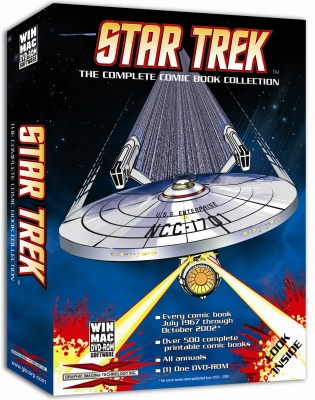
If you're more interested in the comic book side of Trek fiction, find yourself a copy of Star Trek: the Complete Comic Book Collection. Graphic Imagining Technology (yes, their acronym is GIT. Stop snickering) has done a splendid job in bringing legal digitized comics to fans at an affordable price. For under 50 bucks, this DVD-Rom brings you hundreds of Trek comics, from all interations, on a single shiny disk.

I have hardly scratched the surface as far as reading this wealth of material, but I have taken the disc for a spin to see what's what. Upon inserting, a menu page opens up in Adobe Acrobat, offering not only a comics option, but also an introductory essay under "history" and short character intros under "Bios". These are both pretty lame and presumably anyone who is into Star Trek enough to buy this already knows everything written here. Under bonus materials you can find five comics produced by Power Records, which came with 45 records dramatizing the story. Alas, the sound file is not included, but still these comics are an interesting curiosity.

Amongst the other comics you will find here:

61 Gold Key comics, as well as supplemental material, produced between 1967 and 1979. I have only read the first few so far, but they barely seem like Star Trek to me; the costumes and the Enterprise are drawn correctly (well except for the afterburner flames shooting out of the warp nacelles), but otherwise they seem like pretty generic SF stories with little knowledge of the Trek universe. I checked issue 61 and it does seem to have a better grasp on the characters, so they must have improved somewhere along the way. Overall, though, I'm not sure how highly these stories are regarded by Trek fandom.

In the DC section, you get about 150 TOS comics that take place in the timeframe of movies III-VI, as well as the first TNG series. Because Malibu had the DS9 license, they had to crossover with another company to bring the two casts together. The gorgeous Debt of Honor graphic novel by Chris Claremont and Adam Hughes is here. An interesting curiosity to be found in this section is Who's Who in Star Trek, which offers character pages of info on TOS cast and villains, a la DC's own Who's Who handbooks for their superhero universe.

Malibu seems not to have had license to do anything other than DS9, but they explored that corner of Trek universe pretty thoroughly, not only with a DS9 monthly but various limited series, even one for the Maquis. There's also a Terek Nor special; I wonder how it jibes with Pocket's recently released Terek Nor prequel trilogy.

The Marvel section has not only the short-lived Post-TMP series from the late 70's but a ton of books that the company published in the 90's after they bought out Malibu. This not only included the main TV series, but comics devoted to Captain Pike and a Starfleet Academy book starring Nog!

The license then bounced back to DC again; specifically to their Wildstorm branch. However, they didn't seem to be overly interested in really mining the franchise, as they only released 30 comics while they had it.

Here's what you won't find on the disc:

Any IDW comics. The newest comics on this disc are from Oct. 2002; IDW gained the license after that.

Any Trek/X-Men crossovers, presumably because Marvel's permission to use the X-Men couldn't be secured.

Any Star Trek newspaper comic strips-- despite the fact that the original solicitations for this DVD advertised their inclusion. Either they are so well-hidden that I can't find them, or someone had a change of heart and decided against adding them-- maybe they ran out of space! But I do feel burned a bit by this case of false advertising.

I doubt that anything will replace the pleasure of grabbing a honest-to-god yellowing-newsprint comic book and taking it with me to whatever cozy corner I like to read. Reading comics on a computer screen is just not fun. But from a research perspective, the convenience of the Complete Comics Collection is just amazing. This amount of material would take hundreds of dollars to collect, and fill up a long box or more to boot. To have it all on one disk is, from a legitimate source rather than illegal download, a terrific convenience and a good value, to boot. Perhaps GIT can ring up Lucas about a Star Wars DVD-rom next?

1.04.2009

Switchblade Honey

Are you getting tired of all this Star Trek talk yet? Are you not a fan? Do you find Star Trek dull, pompous and ridiculously self-important? Are you happy that Enterprise got canned and there's no new Trek show clogging up the airwaves? Mate, has Warren Ellis got a comic for you!

According to this book's introduction, Ellis was subjected to entirely too much Trek while his girlfriend was convalescing after childbirth and came up with the idea for this graphic novel as a result. It occurred to him that, more than anyone in the world, he would want to see British character actor Ray Winstone as the captain of a Federation starship. As he ruminated on the idea "all my loathing of that profoundly ordinary, polite, self-important and bland future presented by TV science fiction came surging up. All yellow, and with bits in."

In this "mental puke", Ellis stacks the deck a bit by presenting us with a sort of evil twin to the Federation. Rather than using a thinly-disguised noble and well-meaning UFP to fulfill the role of straight-man, he stacks the deck by making the Earth alliance a bunch of right bastards. Far from following a Prime Directive, humanity in this future lands wherever they want to, and rape the land and the locals however they see fit. This comes back to bite them on the ass when they make a mess of the Chasta's homeworld. What no one realized was that the Chasta only choose to present themselves as simple and primitive for aesthetic reasons; they are actually packed with implanted technology, telepathically connected via hive mind, and consider the invading humans to be "ebola with shoes."

The war with the Chasta has gone so poorly that Earth is a month away from being occupied by the enemy. The situation is so desperate that one maverick general decides to spring some incarcerated officers and turn them loose on the Chasta. Of course, since the military are a bunch of assholes, it turns out that most of the characters are in prison for bogus reasons. The anti-hero of the tale, John Ryder, is being detained for disobeying orders to destroy a friendly vessel in order to wipe out the Chasta attackers in its wake. His new gunner is in prison for refusing to fire on civilians, and his electronics expert is being punished for figuring out a way to kill Chasta by blowing out all the airlocks on their ship-- thus depriving the gunner, a rear admiral's son, a chance at a medal. John's new first officer, Susan Nile, castrated her captain when she caught him raping a junior officer. So these people are all "criminals", but ones that you actively root for.

Many stories have a macguffin to get the action going; in the case of Switchblade Honey just about everything in the book: the setting, the mission, the plot, are all one big macguffin in service of getting these colorful characters together, bouncing off each other and doing their thing. And basically their thing is smoking, drinking and swearing. Ellis calls this book anti-Star Trek, "an extended gag at the colourless, clean SF of the big media." Simply put, it's an excuse to get Winstone on the bridge of a Federation starship, bouncing a cigarette butt off the back of his straight-arrow pilot's head and calling him a "twat". Notice how the titular spaceship has a cheshire grin on the cover of the book?

This story might be pretty lightweight, but they sure didn't skimp on the artwork. Brandon McKinney is a polished penciller who takes the project seriously, regardless of the actual content. I see hints of Dave Gibbons and Alan Davis here, but McKinney most closely resembles Mark Bagley. If you ask me, that's pretty good company to be in. It's a testament to Warren Ellis as a force in this industry that no matter which publisher he's writing for or how much of a lark the project is, he always attracts first-rate artists to work with.

I'm not entirely clear on the publishing history of Switchblade Honey; I guess it was originally published in 2003, although it was recently resolicited in Previews, which is when I ordered it. Perhaps this is a new printing. At any rate, this book gets most of its mileage out of enjoyment of the kind of rough, sarcastic, borderline misanthropic characters Ellis (not to mention Garth Ennis and Mark Millar) likes to use. At this point, though, this archetype has sort of lost its attraction for me due to extreme overuse, meaning this book may primarily be of interest to diehard Ellis fans and fervent Star Trek haters.

Rating: 7/10

12.21.2008

The Enterprise Experiment

IDW is the latest in a long line of comic publishers to take a crack at the Star Trek franchise. Over the years, Gold Key, Marvel, DC, Malibu and Wildstorm have produced Star Trek comics, but I’ve never been overly impressed with any company’s version. For one thing, Star Trek rarely seems to attract top-notch artists. And while Lucasfilm over the years has done an admirable job of coordinating all their tie-ins so they fit in one coherent overall storyline, the Star Trek series are all over the place, and don’t tie together well at all. Do the IDW books fall into the same trap?

The Enterprise Experiment was co-written by D.C. Fontana, who is a veritable legend among Trek writers, having been consistently involved with the franchise from its inception. Fontana has written episodes of Star Trek, the Animated Series, the Next Generation, and Deep Space Nine, as well as the novel Vulcan’s Glory and the scripts for several Trek video games. She obviously has a very intimate knowledge of these characters and their universe, which comes through clearly on the page. I do have to question, though, whether the non-Trekkie who is not versed in the lore will be able to pick this up and enjoy it as straight science fiction adventure.

The first two issues of the Enterprise Experiment serve as a sequel to the classic TOS episode “The Enterprise Incident”, which was also written by Fontana 40 years ago. In that story, Spock hoodwinked a female Romulan commander and the Enterprise made off with the Romulans’ cloaking device. This book opens about 2 years later and the Enterprise has been selected to test out the Federation’s own version of the device. Unfortunately, all does not go as planned and the ship and her crew begin to slowly phase out of their proper dimensional plane. In the midst of this crisis, who should show up on the scene but a Romulan bird of prey, commanded by the very same commander who lost her cloaking device in the first place? (what, I ask you, what are the odds?) The majority of this two-parter consists of a running (and floating, when the artificial gravity goes out) firefight with a Romulan boarding party, while Scotty is frantically trying to solidify the ship before everyone fades out of existence.

The artist on this book is Gordon Purcell, who also has been associated with Trek for a pretty long time, having pencilled many issues of the DC Star Trek series during the eighties and nineties. I’m sorry to say that I find Purcell’s work to be competent and serviceable while being almost completely uninteresting and unexciting. In fact, the artwork is so dull that I almost dozed off just now while typing Purcell’s name. I feel like Purcell gets these gigs primarily because he is quite good at making the character’s likenesses match the real actors who play them. While that would be a neat bonus if Bones looks like DeForrest Kelley and Sulu looks like George Takei (Oh my!) it’s of much less importance to me than exciting storytelling and fantastic imagery, which this book unfortunately lacks.

By the way, the script doesn’t do Purcell any favors, either. Way too much of this book takes place in the interiors of ships and shuttles. It reminds me of “bottle shows” of bygone Trek series, where the producers needed to save budget so the entire episode would take place on pre-existing sets. This is a comic, for Surak’s sake, they can take the adventure literally anywhere and have nearly anything happen, yet we get page after page of constricting ship interiors. Even when the story calls for some eye-popping visuals they still blow it. At one point, in order to escape from the Romulans, Kirk decides to fly the phased Enterprise right through a pulsar. Surely that would make for an exciting page of visuals, right? For some unfathomable reason the decision was made to set this scene on the bridge with no exterior shots at all! The only panel to even suggest that they are flying through a star shows the bridge crew shielding their eyes from the blinding glare! (And by the way, couldn't they just turn off the viewscreen until they make it out the other side? Sheesh!)

The third and fourth issues comprise a second adventure, in which the Klingon Captain Kor gains possession of a powerful artifact of the ancient alien race known as the Preservers. The device resembles a similar device that messed with Kirk's head on the planet Amerind (in "The Paradise Syndrome"), and Kirk is desperate that the Klingons should not gain the knowledge of this incomprehensibly advanced technology. The crew actually gets to get off the ship in this one, going planetside and also storming the Klingons' base to steal the artifact back. Sulu gets a moment in the sun disguised as a Klingon and seeing some undercover action.

One of the strongest elements of this miniseries is how effortlessly Fontana and her co-writer Derek Chester weave together disparate elements of Trek continuity and work them into a coherent narrative. The final part of this tale leads to a confrontation with a member of the Organians, who previously enforced a policy of non-violence between humans and Klingons. In the final pages we learn some interesting tidbits about the Preservers, including that the Organians serve them, the Great Galactic Barrier was created by them, and that they predict Lt. Arex's race the Edosians have an important role to play in the future development of the galaxy. You will also see flashback cameos with Jim's nephew Kirk, McCoy's daughter JoAnna, Sarek, Carol and David Marcus. And the phasing/cloak connection clearly foreshadows the TNG episode "The Pegasus". Again, Trek fans will probably be intrigued by what I just wrote, everyone else is likely to scratch their heads and say "The what now?"

These IDW miniseries are being billed as Star Trek: Year Four, the premise being to show the fourth year of the Enterprise's five-year mission, if the show hadn't been cancelled when it was. Which seems a bit laughable because there are already roughly a couple of hundred books and comics covering this same time period. However, upon further examination while Fontana and Chester draw on tons of TV and movie references, this book pretty much ignores all the other previous tie-in material. For instance, a quick look at Memory Beta shows that, including this mini, there are now at least 3 different creators of the Galactic Barrier, and several different explanations as to why the Organians stopped intervening in violence between the Federation and the Klingon empire. Like I said, Star Wars expanded universe is well done, Trek expanded universe is a big incoherent mess.

I feel like I need to give The Enterprise Experiment two ratings, one for Trekkies and one for the non-initiated. I think that Trek fans will dig the characterization, the bits of Trek lore peppered throughout, and the interesting way the creators tie various elements of the history together, at the same time teasing intriguing future storylines. Those who don't know Trek are likely to see some blandly rendered gunfights, some chasing, a bit of trickery, and a lot of weird retro looking clothes and sets. This comic is preaching to the choir.

Trekkie rating: 7.5/10
Non-Trekkie rating: 6/10

12.16.2008

Dead Space (Hardcover Collection)

Having already reviewed the Dead Space DVD a few weeks back, it’s now time for me to turn my attention to the comic miniseries that first got the ball rolling. That’s just the backwards kind of a guy I am. This Image series by Antony Johnston and Ben Templesmith is collected in a very nice hardcover and recounts the initial uncovering of the mysterious alien “Marker” on the mining planet of Aegis 7.

In the film, the unrest caused by the hardcore Unitologist faction is just one of the several plot threads running through the story. Here, the conflict between the devout and the non-believers is the central narrative that drives the storyline. Because they are convinced that the Marker is a cornerstone of their faith, the Unitologists among the miners become obsessed with seeing it, touching it, being near it, and are obviously very concerned with how the discovery is handled. The Unitologists are righteous and the skeptics are annoyed, and tensions build very quickly under the artifact’s not-so-subtle influence. Soon the entire colony is a powder keg ready to blow.

Here’s my problem with this scenario: it’s never really made clear why the Unitologists are the target of such derision right from the outset. In the future timeline of this universe, is all religion considered supernatural hokum and nonsense? Or is there a reason why Unitology in particular is worthy of such scorn from the others? Because it is never explained, the non-religious miners come off as judgmental pricks. I mean, I don’t have a religious bone in my body, but when I see someone wearing a yarmulke or making the sign of the cross I don’t run up to them and tell them how irrational and foolish they are; that would be obnoxious. Security Chief Bram Neumann is meant to be our P.O.V. character, but he’s set up in the early going as an intolerant bully. The Unitologists are kooks and everyone else is mean, so is there anyone to root for here?

Granted, once the Marker really starts to mess up everyone’s minds, the Unitologists all go off the deep end and do some crazy shit. But even the non-believers are somewhat affected, losing sleep and seeing dead people. Murders and suicides begin to escalate, people barricade themselves in their rooms and draw on the walls, and oh yeah, there’s a weird fungus growing in the air ducts. And then, of course, the Necromorphs come and everyone is equally screwed, believer or not.

Neumann does what he can to figure out what the hell is going on before it all escalates out of control, but he is dealing with increasingly-crazed zealots, increasingly-violent insomniacs, and an ever-growing alien malevolence. He won't get any help from his "superiors": both the director of colony and the captain of the Ishimura are die-hard Unitologists whose only concern is the safe handling and relocation of the Marker, regardless of how many people die in the meantime. This is one of those horror scenarios where the writing on the wall says everyone is screwed, and it becomes a question of whether a small handful might somehow escaped or everyone is doomed.

Even after both reading the comic and seeing the movie, I still remain unclear about the connections between the Marker, the Unitologists, and the Necromorphs. It seems to be implied that the Marker is a fake, meant to dupe the Unitologists because their weak wills make them more susceptible to mental manipulation. But if so where did the fake marker come from, and who or what would go to such elaborate lengths to guarantee that the perfect conditions would be met to support a deadly virus that would create an army of zombie demons? To what end? I decided to wiki the game to see if there is some closure to these issues, but apparently not. You would think after dropping around a hundred bucks for a book, DVD and game you could at least expect that some of these mysteries would be resolved, but apparently we are meant to do some reading between the lines and drawing of our own conclusions. Either that or they are counting on everyone to come back for the sequel!

(By the way, the character bios in the front of this hardcover include what may be a very telling error in the text of Director Carthusia's bio, explaining that "his family has been a respected pillar of the Church of Scientology for three generations..." Scientology? I thought the religion in this series is called Unitology. Hmm...

Both comic and movie have a goodly amount of creepy excitement, but they also are so similar that I would only recommend that a die-hard fan of this universe buy them both. For everyone else, one or the other would do. For me, the comic is the better-looking of the two. One of my few disappointments with the movie was the art style on the characters which was very generic 80's to me. On the other hand, there is no disputing that Ben Templesmith has a very interesting and distinct art style; it might not be everyone's cup of tea but I mostly dug it (although I'm not a fan of how he draws hands). I'm not sure if Templesmith did the coloring as well (there's no separate colorist credited), but whoever was responsible did a fantastic job, giving the whole scenario a dark and tense look through interesting palette choices and shading. I think this is one of the first times I've even mentioned the colorist in a review, which says something about how good I think this book looks.

In terms of an overall horror experience, I would probably give the edge to the film. If you are trying to unnerve a viewer, the luxury of movement, music , sound effects, and voice acting trumps a static comic page, for me at least. However, this is a nice looking book and if you are a fan of horror comics you should find it a satisfying read.

Rating: 7/10

12.07.2008

The Umbrella Academy: Apocalypse Suite

I’m a bit late getting on the Umbrella Academy bandwagon. Lots of other comics readers in the know have been touting its virtues for some time now. I actually got the trade when it was released, but it’s been sitting at the bottom of my read pile ’til this week. I’ve been working through the great podcasts the boys over at Major Spoilers have been producing and when I saw they would be looking at Umbrella Academy in their next edition (actually their July 15 edition, I am just behind the times on so many levels) I finally yanked it out and gave it a look. Man alive, am I sorry I put it off. This miniseries was a blast and a half!

It comes as no surprise that Grant Morrison provides the introduction for this collected edition; the mad genius of Morrison’s early Vertigo work was clearly a big influence on writer Gerard Way (which he readily admits in interviews). The heroes of this fractured tale include a space hero with the body of a gorilla and a sixty-year-old time traveler trapped in the body of a ten-year-old boy. Their parents are a disguised space alien and an ambulatory mannequin. Amongst the enemies they face are flying robot heads belching disintegrating death, an insane Conductor who yearns to orchestrate the apocalypse, and the Eiffel Tower itself, which comes to life and begins slaughtering its visitors. The Umbrella Academy is the most successful blending of superheroics, surrealism and silliness since Morrison’s legendary run on the Doom Patrol.

Consider the high concept behind out heroes' origins: 43 babies are simultaneously born around the world to 43 shocked mothers via immaculate conception. They either die or are abandoned. Sir Reginald Hargreeves A.K.A. the Monocle, “world-renowned scientist and wealthy entrepreneur” manages to track down 7 of these strange miracle babies, and adopts them with the intention of raising them to be superheroes.

As time progresses, the Monocle proves to be a much more effective taskmaster and field general than a dad. In fact, he doesn’t seem to have a paternal bone in his body. As a rule, he only refers to his gifted children as numbers 1-7, and he has no compunction about flat-out telling his non-powered seventh protégé Vanya that “there’s just nothing special about you.” By the time the story catches up to the present, the disillusioned Umbrella Academics are aged 30 and no longer a team: one brother is dead, another is lost in time, and the rest have gone their separate ways.

Way uses the tried and true plot device employed by many an indy drama to draw his fractured family back to the Academy: the sudden death by heart attack of the Monocle. It turns out that very few wounds have healed with the passage of time and the dysfunctional family seems to pick up their various grievances where they left off years before. Tragically, Vanya is still made to feel the outsider by her siblings, which is a turn that will have tragic consequences not too far down the road.

If there’s one criticism I could level at Umbrella Academy, it's that I hope that as Gerard Way develops as a writer he understands that there’s sometimes a fine line between righteous indignation and overbearingly whiny self-pity. To invoke comedian Artie Lange, there are a lot of “Wah” moments in this mini: “Wah! My daddy didn’t love me enough” “Wah! My adopted sister doesn’t wanna go out with me!” “Wah! My father stuck my head on the body of a gorilla” Well, okay, maybe we’ll let that last one slide. All this angsting and drama might be more palatable if the heroes were teenagers, but they’re all entering their thirties. Shouldn’t they have gained a little perspective by now? At some points I wanted to reach into the comic and grab some of these characters by the shoulders, shake em around a bit and tell them to grow a set and stop being such crybabies.

But enough grousing-- back to the unbridled heaping of praise! Let’s talk about the phenomenal Gabriel Ba, who as far can see is the absolute perfect artist for this material. His art is stylized without being overly-cartoony, incredibly imaginative and successful at combining all the bizarre elements Way feverishly worked into his script and convincingly making them co-exist in the same startling world. There’s so much great stuff to look at here, the word balloons sometimes just seem like merely a special added bonus. I took such a liking to Ba’s style, I immediately placed my order for Casanova, the espionage book he did for Image with Matt Fraction.

Like Grant Morrison before him, Gerard Way is absolutely bursting with ideas, so much so that there are throwaway lines and unresolved plot threads that could fuel future Umbrella Academy epics for years to come. There is, of course, the question of the children’s birth: how did they come to be born and what was the fate of the other 36 babies? And if they were born all over the world, why are they all Caucasian? And what the heck does a burly wrestler defeating a giant squid alien in the ring have to do with it? Also, the fact that Hargreeves was an extraterrestrial was mentioned just once in this book, and then never brought up again. Happily, although Way is presumably quite busy with his day job (from what I understand he bums around playing in a band), he is already hard at work on the sequel miniseries Umbrella Academy: Texas, in which we will very likely learn more about Number 5 and his time-tossed misadventures. Pick up the first issue (released last week) and this trade and you will be all up to speed on the most imaginative and fun superteam to come along in quite some time. And if you consider how many superhero teams there are glutting up the market, that’s really saying something.

Rating: 9.5/10

12.05.2008

Dog Eaters #1

The opening captions of this new Dabel Brothers miniseries do an effective job of establishing the setting and mood of this post-apocalyptic adventure:

“Mankind failed in its first attempt to transcend the Petroleum Age. The Die Off killed nine out of ten people worldwide.

“One hundred and seventy five years later, civilization consists of scattered nomadic tribes, isolated casino-cities, and roving bands of predatory bandits. This is the world of the Black Dog clan.”


Dog Eaters, then, is a Road Warrior pastiche crossed with an old-school wagon trail western. Only instead of traversing the wasteland in horse-drawn covered wagons, the extended family of the Black Dogs travel in a variety of tricked-out armed and armored trucks, RVs and such. Where they come up the gasoline, engine oil and tires remains a mystery.

Lamont, leader of the clan, has an admirable endgame in mind: to settle on a gulf coast and establish a new city. In order to make that dream a reality, his intrepid convoy makes delivery runs across the tortured landscape. Naturally, there are rival clans on the prowl who are not so noble of purpose…

The main action set-piece of this issue concerns a gunfight with such a clan, a wild pack of mohawked punk bikers straight out of central casting. Fans of gunplay and carnage should enjoy the show, though having the majority of the issue dedicated to one long action scene may leave the reader feeling the story raced by too fast and they didn’t get their four dollars’ worth. Writer Malcolm Wong does manage to shoehorn some character development into the last few pages. There are a few tender moments between the Dogs’ pigtailed tween gunner Tracy and the Northern nomad she accidentally shot down during the fight. There is also an intriguing love rectangle developing as Lamont moves out of his first mate’s trailer and weds a younger girl he’s impregnated-- a girl who formerly was dating one of the young bucks in the clan.

Guillermo A. Angel’s artwork shows both manga and European influences. The character designs are interesting. Some of the violence gets rather gory at times (which is not a minus in my book, I just thought squeamish readers). There were a few cases where I wasn’t quite sure what I was looking at, for example before the fight Tracy is talking to a little dog and for the life of me I can’t figure out if “Mr. Fluffy” is meant to be a real dog or a toy. (If he is real he’d better watch his back, considering the title or the comic and all) But for the most part, the art is quite good.

Dog Eaters may deserve some flak for its derivativeness and spotty pacing, but overall I have to say I enjoyed it. After one issue its hard to predict whether it will ultimately satisfy, but I liked it enough to check back in next issue to see what Wong and Angel have in store.

Oh, and by the way: I don't recommend that anyone google "dog eaters". You will get a lot of hits that have nothing to do with this comic. Trust me, don't go there.

Rating: 7.5/10